
Framing Fairness
Last week, Katie Scarpa sent me this article on “peanut butter” raises, which seem to be the compensation strategy du jour. Apparently, half of companies surveyed this year are considering giving all their workers the exact same percentage increase, regardless of performance. Which, while it isn’t the laziest/racist/sexist compensation strategy I’ve ever heard of, is pretty close. And it highlights the importance of how the fairness frame is weaponized and what we can do about it.
I get why companies are pursuing this strategy; they will probably avoid a few lawsuits because a flat percentage has the appearance of fairness. After all, for most people, “equal” and “fair” are synonymous.
But what kind of equality are we talking about?
In a peanut butter raise, employers are using an equal percentage rather than equal amounts. You could easily argue that using equal amounts is also reasonable; “everyone gets $5k” sounds just as fair as “everyone gets 5%.” But since the percentage-based strategy benefits highly paid workers (like those who typically set compensation), that is the fairness frame that companies are choosing.
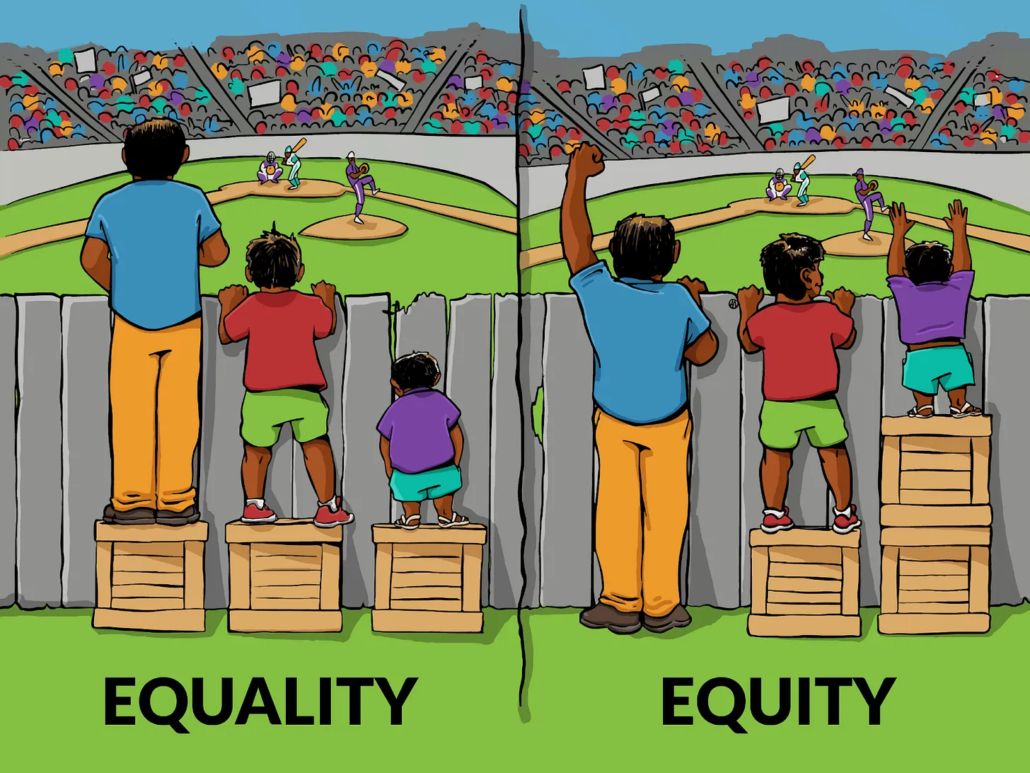
Percentage versus amount are two different kinds of fairness frames that center around process. But it is equally reasonable to talk about fairness of outcome. For example, the famous “equality” versus “equity” carton juxtaposes equality of process versus equality of outcome.
Presented in isolation and as statements, each one can feel fair: “everyone gets a box” versus “everyone can see the game.” And each frame can criticize the other as unfair: “they can’t all see the game” versus “they didn’t all get a box.”
But it feels immediately different when they are put next to each other and made tangible. Rather than driving toward convenient fairness, comparison forces discussion and that’s the trick to avoiding most framing effects: they rarely work when all the frames are made salient by putting them next to each other, so that both process and outcome are clear.
We can use the same trick to look at peanut butter raises.
Peanut butter raises are unfair, because they don’t address existing compensation issues; companies are already underpaying based on race and gender, so using across-the-board raises means perpetuating harm. Just like in the cartoon, the raise does nothing to eliminate the inequity.
But amount-based peanut butter raises are less unfair than percentage-based peanut butter raises and showing that just takes comparison to eliminate the frames. If you use a flat 5%, a Black woman making $50k gets less ($2.5k) than the White man making $100k ($5k) for doing the same work; the $50k gap is now a $52.5k gap and gets wider and wider, year-over-year. Using a flat $5k, at least the $50k gap stays the same.


Leave a Reply
Want to join the discussion?Feel free to contribute!