Gambling is our generation’s smoking. And for applied behavioral scientists who choose to work in the industry, “I didn’t know” isn’t going to be an excuse.

To understand the problem, you first have to understand the scope. Gambling is big business, bigger than most people think: ~$70b in revenue last year in the US. That’s roughly the same as cigarette revenue.

And that business is directly connected to repetitive behaviors: a quarter of adult Americans are daily gamblers. Compare that to only a tenth that smoke daily. And the discrepancy will only get bigger, as youth gambling grows and elderly smokers die.

Those base rates matter. It is relatively easier to get people to increase the frequency of a behavior than it is to get them to start; it is easier to get existing gamblers to place more bets than it is to recruit new smokers. Which means dollar-for-dollar, the gambling industry is much more interested in applied behavioral science.

The job ads tell the story. Gambling companies (and yes, prediction markets are gambling companies) are already largely numbers-driven and predisposed to value the kind of methodical approach that applied behavioral scientists bring. And so it is no surprise that even a cursory look at the careers page of companies like Draft Kings and PolyMarket have plenty of job descriptions with terms like experimentation.

Especially in a bad market, those jobs are tempting: well-paid, advertised as fun because “gambling is entertainment”, and full of like-minded people who tend to be evidence-driven. My favorite Shakespeare quote applies: “My poverty, but not my will, consents.”

But there can be no illusion about the harm. ~60% of gambling revenue comes from people who are doing it at dangerous levels, destroying not only their own economic life but wreaking havoc on those around them. Just like drug addiction, gambling addiction means collateral damage.

And most people are aware. When four out of five folks recognize gambling addiction to be just as serious as alcohol addiction (and one in three believe it is more serious), ignorance is going to be a very poor defense.

Especially when it bleeds over into geopolitics. Six accounts made around $1 million in profit by correctly betting that the US would strike Iran in the hours before it happened. The accounts were newly made and placed no other bets. Subsequently, the White House issued a memo to staffers warning them against such behavior.

At best, it is war profiteering. At worst, it is war creating.

So do your career a favor and just say no. To be explicit about inhibiting pressures: from now on, if you are choosing to work in this space, my door is closed to you. But if you want to get out or find other options, I have open office hours for a reason, I will do all I can to help, and I am calling on other folks to do the same. Let’s create a pathway to meaningful work that doesn’t mean destroying the world.


Al Pacino got it right in The Devil’s Advocate: for all our advances in greed, lust, and gluttony, vanity is still the Devil’s favorite sin. If your users want to tell you how they’re exploiting your systems: let them.

A few weeks back, the NYT wrote an article about Matthew Gallagher and how his two-person, AI-powered company selling pharmaceuticals online was on track to do $1.8b in sales this year. I can’t tell if the reporter, Erin Griffith, just didn’t do much fact-checking or was gleefully content to let Gallagher dig his own grave but the article is a trainwreck.

Gallagher meets her at Soho House and namedrops VC advisors, but says he has “told hardly anyone about his company.” For good reason, it turns out. Griffith briefly mentions some “AI slop” and faked before-and-after weight loss photos. But as the internet quickly took over the investigative part of her job, it was revealed that Gallagher’s company has an F with the BBB, is being sued, and the FDA is already circling.

Gallagher is an experienced serial founder who has worked in VC. And this is not his first time doing shady shit; the Reddit stories about his previous company, Watch Gang, are a horror show and he is, fairly objectively, not a good guy.

So why paint a target on his own back by doing the article?

Because this is the era of Trump, of Tate, of Musk. It seems ahistorical to argue that they are more greedy, lusty, or gluttonous than previous generations; we have plenty of evidence that wealth has always been exploitative. But vanity, coupled with the powerful channel that is the internet, has become an irresistible lure.

This may be temporary; someday, an SEC with teeth will come for Musk, just as an FDA with teeth will come for Gallagher, and those public examples will force folks like them back into the shadows. But for now, vanity is a powerful tool for finding the fault in your own systems.

Start with a Reddit search for your company. Are folks sharing interview answers? Exploiting coupon codes? Loading up with pricing mistakes? Chances are, if you’re big enough, you’ll find at least something that you can use to improve your service.

While you’re there, consider leaving a honeypot, a la Pacino. “Anyone found a way to cheat on the Oceans Talent aptitude assessment?” will bring the vain out of the woodwork, because for many, the only thing more fun than cheating is bragging about it.

And sometimes, a “hack” is just an invitation to build a new feature. I’m always reminded of Mike Flowers’ team in the NYC government, who were amazing at finding clever ways to close gaps. For restaurants that were dumping their grease down the drain, Flowers’ team introduced them to biofuel companies that would happily recycle their oil for free. For ambulances that were parked instead of circling, they introduced new parking spots that were better distributed. Just because Gallagher needs to go to jail doesn’t mean the only response to subversion is punishment.

Because it is a complex system, most of life is a choice between differing errors. So rather than trying to be on time and ending up accidentally early or late, it is better to make leading or lagging a specific choice.

I love surfing. It is relaxing to be in the water and when you catch a good wave, you’re actually flying. But like boxing (my other favorite sport), surfing is about timing. If you go too early, the wave crests on top of you; if you’re too late, you miss the momentum and bob over the top. To surf, you have to be close enough to the right time to balance the two forces.

Fortunately, you can intervene. If you’re slightly too early, you can cut along the wave to bleed off momentum and prevent crashing out; if you’re slightly too late, you can pump a little to generate speed. In reality, you’re always doing one of these, because you’ll never be perfectly on time.

So good surfers make an explicit choice of errors. Rather than trying to be perfect, they acknowledge the reality of imperfect timing and make a strategic decision to either cut or pump based on the reality of the situation. And the earlier they recognize early versus late and make an adjustment, the better they surf.

While recording Jez Groom’s episode of An N of 1, he mentioned that his weakness in the workplace was giving people responsibility too early on. I remember because it resonated: I’ve often been guilty of the same thing, reasoning that it was better to frustrate someone by forcing the pace of their growth than by holding them back.

But by choosing in advance a specific early/late strategy, Jez and I can put in place safeguards to adjust for the limitation. Consciously giving people too much responsibility means also building a safety net for when it doesn’t work out; giving them not enough responsibility means also creating innovation forums for them to channel their additional energy into.

Microsoft is a great example of doing this well (and really, really badly). As was pointed out to me when I joined, MSFT has never been first to anything. It wasn’t the first mainstream GUI (Apple), first-party premium laptop (MacBook), productivity suite (WordPerfect), search (Google), cloud (AWS), modern console (PlayStation)…the list goes on. And yet it has achieved significant ($billion+) market share in each of those verticals by getting great at being late. Ride the tail of the wave, pump your way to the mid, call it a day.

But, of course, even the best surfers have bad rides, especially when they try to switch strategies. Microsoft tried to be early to AI and while the day isn’t done, that is likely to have been a waste in retrospect. There are other failed attempts to be early (Zune Music Pass? Microsoft Band?), which feels inevitable when a company with a fantastic playbook for one thing tries to do something completely different.

Don’t make the same mistake. Be deliberate, choose your error, and then hedge your way to the right place on the wave.

Working with global talent will make you better at what you do, because insight is driven by diversity. It will also redefine what privilege means.


I get it: your gas prices went up (although the photos people keep posting are lower than pre-war in California). The Pentagon just asked the White House for another $200b of your tax dollars (twice as much as the total cost of food stamps). Your airfare for spring break is expensive.

But I work with 500+ Sri Lankans at Oceans. Sri Lanka, like much of the developing world, doesn’t have their own oil or a massive strategic reserve. They have already initiated mandatory gas rationing via QR code and even/odd license plate days to avoid queuing behaviors.

Next up, we expect rolling power outages that not only affect every aspect of their daily lives but specifically their ability to do the jobs that earn that money to pay for gas. And for everything else, which will now become increasingly expensive as the importation process slows. It is not hyperbolic to predict that some people will die from the ripples of a war that America started on the other side of the world.

For most Americans, the war is an inconvenience; in other places, it is a devastation.

I spend a quarter of my time in Sri Lanka, because our team deserves a leader that works alongside them. Normally at this time of year, I’d be flying over to sprint on our next set of objectives and to get ready for Avurudu/Puthandu, the Sri Lankan New Year. But with Qatar airspace closed and dwindling fuel supplies, there is a very real chance that I would get to Sri Lanka but not be able to get back. And so I’m home in San Diego, safe and sound.

Oceans is fortunate. We have cash reserves and a business continuity plan that will allow us to continue our service uninterrupted. We are conserving by choice, as a civic obligation that will help Sri Lanka stretch its fuel supplies as long as possible; offline trainings are moving online, coworking spaces are being set up with UPS backups to deal with power outages. We’ll be fine.

But as an American, and alongside our hundreds of clients, I’m being reminded about my own place in all this. I’m thinking about the conservation that I should be making a daily part of my life, not just during a war; I spent an hour today optimizing some of our household operations to reduce our footprint.

If business is the process of profitable problem solving, inviting in the challenges of the wider world is directly accretive to our ability to be good at business. When you hire global talent, you get exposed to circles far beyond your own, with unique circumstances, challenges, and solutions.

When Brooks at Cheers writes about working with Anjalie, he talks about how she has broadened his perspective; Cheers hyperscaling growth isn’t an unrelated fact. Good leaders are not just of the world but IN the world. Not just their world, not just posting pictures of gas prices at their pump, but recognizing just how much further this all goes.

Because if the most important day at your company is someone’s first, then the second most important is their last.

My favorite scene in Moneyball is Brad Pitt teaching Jonah Hill how to fire a player. Not only does it give some good practical advice, but it also shows just how hard this conversation actually is; Hill’s character is entirely well-intentioned but still manages to bungle it. Firing is a skill worth learning to do correctly.

At Oceans, before anyone does a termination (whether for performance or gross negligence), they practice that call with me. We start by doing a roleplay, with the manager telling me that today will be my last day. If they start to go off track, I immediately stop it; you don’t want people to practice doing the wrong thing and then correct, because every repetition makes it harder to shake.

If I need to stop them, we discuss the right approach and then flip: I become the manager and model the right way to have the conversation. Then we flip again and the original manager practices until we get it right, which may require more flips.

And that’s OK. If you’re doing things right, terminations are the worst kind of event: rare and important. Rare and unimportant conversations are easy to ad-lib, frequent and important are easy to routinize.

As Brad Pitt says, the best way to fire someone is to deliver the minimum necessary information, while leaving the door open for further conversation. You can’t script it, because it comes off as inhumane, so you have to understand the basic building blocks and then be willing to adjust.

Start with the essential context setting: this is going to be a difficult conversation, you want to be respectful, you’re going to start with the most important facts. At Oceans, those facts are: today is your last day, we cannot confidentially keep you in this business role, what type of termination it is (this matter because gross negligence means you are ineligible to rejoin the company, while performance termination does allow you to return in a year and we’ve had several people do so), and that HR will be in touch with logistic details.

And that’s it. Open the floor for questions and hold space, but don’t force more than that; the essentials have been delivered.

Never impose feedback. Often, we feel the need to explain to people what they did wrong that resulted in the termination. But that is actually for our benefit: it makes us feel better and justified. Assuming that yours is a desirable workplace, you are delivering bad news to someone and even if they are eventually interested in feedback, they may not be in a place where they can hear it at the same time as processing that they no longer have a job.

At the same time, if they want feedback, you have to be ready to give it to them. Use behavioral examples and always tie them back to “and thus we cannot confidently have you in [business function] right now”; this helps depersonalize and sets the context as a business decision. If they don’t, you can offer to have a separate feedback session at a later time if they want.

If they try to give you feedback, redirect those to a separate exit interview; at Oceans, managers do the terminations but everyone has an exit interview with me where I gather feedback on how we could do better. You want this to be about them, not the company, but explicitly recognize that they will have an opportunity to share their thoughts.

Finally, try to end it on a positive and personal note. Because of the peak-end rule, the person’s subjective impression of the experience will be defined by the worst moment and the last one. At Oceans, that can include things like “Speaking on a personal level, I’d love to see you back here again in a year” or “I really appreciated [specific example] and I hope you continue that going forward.”

Firing is hard. It is worth practicing and improving. Ten years from now, I’m sure I’ll think about it differently than I do now. And that’s a good thing; of all the places to avoid foolish consistency, the second-most-important day is certainly one.

The secret to effective scaling is all about planning for the relationship between probability and periodicity.

At Oceans, my leadership team likes to joke about Matt Math; it’s shorthand for my tendency to use the same syllogism about scaling over and over. The premise is simple: if something happens once a year with 100 people, it’ll happen once a month at 1,000 people, and once a week at 5,000.

Yes, the math isn’t perfect: I know there are 12 months and 52 weeks. But it is a handy shorthand for remembering when to stop treating events as exceptional. Matt Math clarifies the why and when of developing processes and hiring people based on our growth curve.

For example, Oceans is 4 years old and the number of Divers who serve our clients has doubled every year. This exponential rate happens because we’re largely a referral business: the number one source of customers is other happy customers and so with very low churn, you get fairly standard exponential growth.

I joined the company at an inflection point in that doubling, as Oceans crossed the magical line where many events moved from yearly to monthly. That meant my first agenda was moving from escalation to processes.

For once-a-year events, you can solve them through simple escalation; as long as there is a clear accountability structure, a leader can just make a decision and move on. Those outliers are a burden but dealing with them as exceptions helps prevent the death-by-process feeling that can crush momentum at early-stage companies.

But when an event is once-a-month, the simple cognitive burden of dealing with that many exceptions will grind the leader to a standstill – you have to pivot to process. And so the rule at Oceans is very clear: if it happens monthly, there needs to be a documented, repeatable way to address it.

And that has largely been the work of my last year at Oceans: paying back the operational debt of being too slow to transition from escalations to processes. Kudos to the team, because in my twenty years at work, I’ve never seen people do so much and so quickly, especially while supporting the once-a-month outliers. There is a very real penalty to waiting too long to put processes in place; if business is choosing between too early and too late, better to be early.

But now we are on to the next phase: in my year here, the number of Divers has doubled and it’ll double again by the end of this year. Which means we’re moving into the once-a-week phase of Oceans and that means we need to transition to the next solution: hiring. Because while a leader can deal with once-a -year escalations and a strong process can manage once-a-month events, only a dedicated team member can deal with the once-a-week reality. Staying lean and keeping burn low matters but so does clear accountability for frequent events.

Obviously, the math continues: once-a-day, once-an-hour, once-a-minute, once-a-second. So you hire a team, then you automate, then you have a team of people automating. And these probability/periodicity connections span the business. A handshake referral deal at once-a-year becomes a referral program at once-a-month becomes a full-time referral program manager at once-a-week. A parental leave decision at once-a-year becomes a parental leave policy at once-a-month becomes a parental leave coordinator at once-a-week.

Because it doesn’t matter if it is Sales or HR; paying attention to probability and periodicity gives organizations a structured approach for maximizing velocity without burning out. Unifying frameworks like these allow everyone to know when it is time to grow, all because of a little simple math.

You can’t hear your workplace accent but it may be stunting your growth.

Earlier this week, I was helping a post-doc prepare for a few upcoming interviews, mostly at big tech companies. And as we role-played her answers, I noticed a recurring pattern: no matter what question I asked, she consistently sounded academic.

An easy example is describing the outcome of research. She emphasized the insights because for her, like most academics, the point of study is knowledge. But in business, insights are simply a pathway to impact; knowing doesn’t do us any good if we can’t find a way to apply it.

Everyone has a workplace accent: patterns of terminology, modes of explanation, and linguistic shortcuts that derive from the role and industry we’re immersed in. And often, the diversity that comes along with multiple accents on a team can be an asset, because creative collision and varied viewpoints unlock more value.

But when your workplace accent is so strong that it prevents you from being understood, like when you’re making the transition from academia to industry, you have to learn how to regionalize or risk losing out on opportunities. Fortunately, just as with intonation, accents are learned and therefore can be modified; all the things you do to train yourself to speak with a particular tonal accent can be effective at changing your workplace accent.

The first step is recognizing you have an accent; most of us can’t truly hear our own. If you grow up in the South, you don’t think of yourself as having a Southern accent because that’s how everyone you know talks. One of the things I hated about my PhD program was the bubble – you spend all your professional and personal time around other grad students and homophily does the rest, driving you toward a particular monoculture.

It is only when I left the bubble that I realized that non-PhDs couldn’t always understand me. If you want to change your workplace accent, you have to be willing to accept that people from other industries and roles don’t perceive you the way you perceive yourself.

Once you’ve acknowledged your workplace accent, you can learn how to hear it and the best way to do that is to listen to other people’s accents. Podcasts, books, 1:1s…anything you can do to expose yourself to the accent of where you want to be instead of where you are will help you appreciate the difference.

And eventually, there is no getting around the fact that you have to practice speaking differently. The hardest part of any linguistic change is moving from listening to talking but since the whole goal here is to be able to fluently switch, there is no path forward that doesn’t involve actually doing it. Find a low stakes environment (you don’t want to be doing it for the first time during an interview) like a local industry meetup, and try consciously and deliberately stepping outside your normal, accented comfort zone.

This is where diversity in your friend group becomes so important. Whether it is hearing your own accent, listening for theirs, or practicing bridging the gap, the reality is that who you are around is going to have a huge impact on your ability to move between accents. So if you’re an academic with no industry friends, let this be the wake up call: time to hop on Bumble Bizz, LunchClub, Meetup, or LinkedIn.

At Oceans, our talent acquisition process has always been fully human: every resume reviewed by a trained recruiter, every interview conducted in-house. But as our application numbers have drifted up (over 20k last year!), the wait time for candidates has gotten longer and longer as we struggle to meet the demands of a company where the headcount doubles every year.

So on my last visit to Sri Lanka, I suggested the possibility of at least partially automating resume screening. To me, it made sense: with years worth of data, training an algorithm to do the initial sort is a reasonable use of technology.

But the team was aghast. Human review has long been a cornerstone of how we recruit and the idea of doing anything else felt like a loss. They mourned those who might get passed over in the shuffle, the exceptions who wouldn’t get discovered by a mere machine.

So I posed a thought experiment: what if automating resume review allowed us to do twice as many phone screens?

The quarter-over-quarter model pushed by Wall Street has trained us to think in terms of reducing headcount; automation means investing in tech to eliminate people, saving money so the stock price goes up. And nowhere is this more noticeable than current discussions about AI, where CEOs with a vested interest tell us that in five years, all white collar jobs will be automated.

But as writer Joanna Maciejewska eloquently put it: “I want AI to do my laundry and dishes so that I can do art and writing, not for AI to do my art and writing so that I can do my laundry and dishes.” Automation isn’t about having more or less hours in a day, it is just about changing the allocation of work to those hours. So when we think about automation, it shouldn’t always be with a “less” framing – we need to balance it with where we are going to redirect the energy.

To do that, I worked with the talent team to draw out our funnel: resume screen, phone screen, aptitude test, interview, etc. Then we looked at the conversion rate and time spent at each step to draw up a budget of where we were spending our resources. And I ended with a simple challenge: “I am not asking you to reduce; keep the time budget the same. But consider where we are most effective and then reallocate the hours to where you think humans make the biggest difference.”

Put that way, automating resume review made perfect sense to them. Would a few diamonds in the rough be missed out on? Sure. But by their own calculation, the additional time spent actually talking to real people and having dynamic conversations would actually help us find more potentially overlooked candidates.

Oceans is heavily skewed toward demographics that have traditionally been overlooked, and we’d like to keep it that way. Automation doesn’t have to be the end of everything good; it is just another tool in the box that can serve whatever goal you have. Yes, sometimes that is cost reduction, but it certainly doesn’t have to be. Wouldn’t it be lovely to hear a CEO say, “I want to keep our costs the same and use automation to increase our quality?”

Last week, Katie Scarpa sent me this article on “peanut butter” raises, which seem to be the compensation strategy du jour. Apparently, half of companies surveyed this year are considering giving all their workers the exact same percentage increase, regardless of performance. Which, while it isn’t the laziest/racist/sexist compensation strategy I’ve ever heard of, is pretty close. And it highlights the importance of how the fairness frame is weaponized and what we can do about it.

I get why companies are pursuing this strategy; they will probably avoid a few lawsuits because a flat percentage has the appearance of fairness. After all, for most people, “equal” and “fair” are synonymous.

But what kind of equality are we talking about?

In a peanut butter raise, employers are using an equal percentage rather than equal amounts. You could easily argue that using equal amounts is also reasonable; “everyone gets $5k” sounds just as fair as “everyone gets 5%.” But since the percentage-based strategy benefits highly paid workers (like those who typically set compensation), that is the fairness frame that companies are choosing.

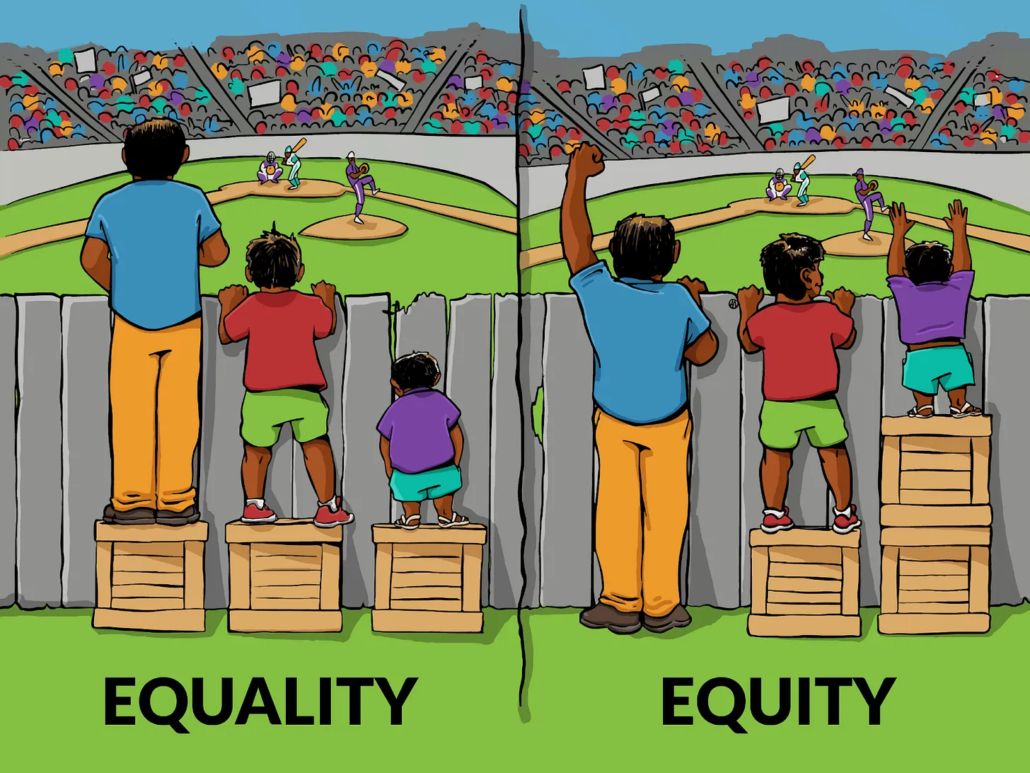
Percentage versus amount are two different kinds of fairness frames that center around process. But it is equally reasonable to talk about fairness of outcome. For example, the famous “equality” versus “equity” carton juxtaposes equality of process versus equality of outcome.

Presented in isolation and as statements, each one can feel fair: “everyone gets a box” versus “everyone can see the game.” And each frame can criticize the other as unfair: “they can’t all see the game” versus “they didn’t all get a box.”

But it feels immediately different when they are put next to each other and made tangible. Rather than driving toward convenient fairness, comparison forces discussion and that’s the trick to avoiding most framing effects: they rarely work when all the frames are made salient by putting them next to each other, so that both process and outcome are clear.

We can use the same trick to look at peanut butter raises.

Peanut butter raises are unfair, because they don’t address existing compensation issues; companies are already underpaying based on race and gender, so using across-the-board raises means perpetuating harm. Just like in the cartoon, the raise does nothing to eliminate the inequity.

But amount-based peanut butter raises are less unfair than percentage-based peanut butter raises and showing that just takes comparison to eliminate the frames. If you use a flat 5%, a Black woman making $50k gets less ($2.5k) than the White man making $100k ($5k) for doing the same work; the $50k gap is now a $52.5k gap and gets wider and wider, year-over-year. Using a flat $5k, at least the $50k gap stays the same.

Recently, one of my leaders (the fabulous Katie Scarpa) went deep with a candidate for a role on her team here at Oceans. Katie had reservations about their tone in an interview but after much discussion (my advice: “Tone is both coachable and easy to get wrong in singular interactions”), decided to send an offer.

The result? A quick decline based on compensation.

But here’s the catch: the salary range was listed in the job posting.

On the one hand, I get it. Companies, especially smaller ones, may not accurately understand the market and need feedback from candidates to adjust their ranges. And in a tough economy, a desperate candidate could apply to everything and then hope to convince a hiring manager to raise the salary once they’re bought in.

But, as in many cases, an emphasis on getting the most for yourself comes at a cost to others.

I’ve long fought for the inclusion of accurate, public salary ranges in job postings. It is nominally the law here in California, although infrequently enforced (I’ve written to the enforcement agency about giving them an automated tool to identify offenders for free; they’ve never written back – I’m looking at you, Lilia Garcia-Brower).

And the research is blazingly clear: public, narrow salary ranges consistently shrink wage gaps, by creating clear anchors and reducing reliance on individual negotiation (which tends to favor overrepresented groups).

But when candidates ignore the posted ranges, the benefits drop away. If there is an expectation of disregarding public salaries, companies are disincentivized from being accurate; it benefits them to post low ranges in order to reduce the anchor point and harvest the most candidate data. Which puts us right back in the same place: overrepresented groups will ignore the ranges and negotiate, underrepresented groups won’t, and wage gaps will persist.

And it goes beyond just the wage gap. While not a perfectly zero-sum game, hiring requires resources that are not infinite; when someone takes up space in the hiring process with no intention of accepting, they deny consideration to other candidates who are willing to work at the posted salary. Katie’s candidate could have dropped out in the first round, allowing us to advance someone else who felt the tradeoff between value creation and compensation was equitable.

It is absolutely good and reasonable to not take jobs that don’t fully compensate you for the value you create and it is beneficial to both workers and employers when salaries are fair. And if you believe that (I do!), the single best thing you can do as a job seeker to create that outcome is to insist that companies post accurate public salary ranges and then only apply to jobs where you consider that tradeoff fair. The power of workers has always been in what they refuse to do, so stop applying to what you won’t accept.